Every office I visit these days is fighting the same invisible enemy: channel chaos. The invoice came on email. The reminder about the meeting arrived on WhatsApp. The updated schedule is hiding inside a school portal nobody checks. And somewhere in between, a parent or a client got left out of the loop entirely.
I run a software company, so I spend a lot of time inside schools and small businesses. Almost every one of them has the same problem: not too little communication, but too much of it in too many places. The fix is rarely a new tool. It is a decision about what belongs where.
Why the wrong channel breaks everything
Here is what I mean. A small school has three channels already: WhatsApp for staff, email for parents, and a portal for student records. That sounds reasonable. But then someone sends an urgent fee reminder over WhatsApp, while the formal invoice goes by email, and the actual balance sits in the portal. Parents who check only email miss the WhatsApp reminder. Parents who live on WhatsApp never open the email. And the portal, the one place with the truth, is checked by almost nobody.
The result is not confusion about communication. It is confusion about money, deadlines, and results. People do not say "I missed a message." They say "nobody told me my child failed the exam" or "I paid but you say I did not." Those are the moments when a channel problem turns into a trust problem.
After years in this business, I know the real question teams need to answer: not "which app is best" but "what kind of information is this, and where does it belong?"
The three kinds of information
In my experience, almost everything a school or small business sends can be sorted into three buckets.
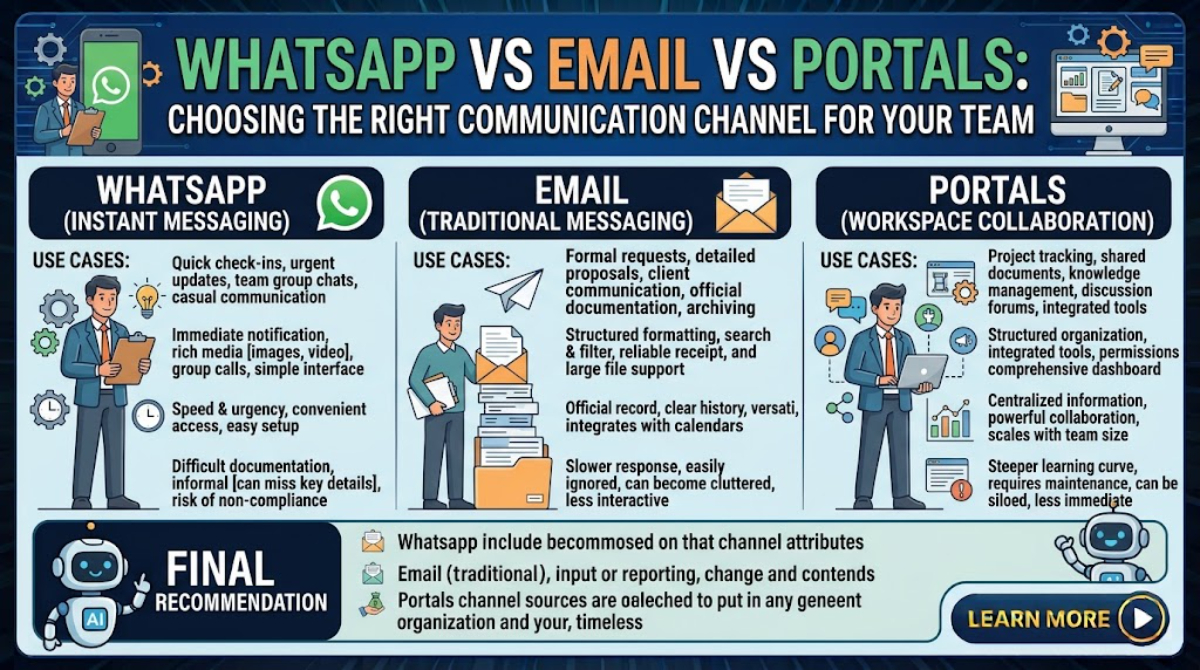
The first bucket is operational chatter. These are quick, time-sensitive, low-ambiguity messages. "The bus is ten minutes late." "The meeting moved to room 2." These need speed, not paperwork. Nobody wants to file an email about a late bus, and nobody should. This is instant messaging territory.
The second bucket is formal records. These are messages with consequences: invoices, contracts, admission letters, attendance summaries, official announcements. You need a record of when they were sent and what they said. If a parent disputes a charge, you want a trail. This is email territory.
The third bucket is structured information. This is data that changes over time and gets looked up repeatedly: a student's fee balance, exam results, a project's budget. Email is a terrible home for it because the answer keeps moving. The balance you quoted in April is not the balance in September. This belongs in a portal, where one source of truth lives and updates itself.
Once you name the three buckets, the chaos usually starts to make sense. The problem is not that people use WhatsApp too much. It is that structured information leaks into WhatsApp, and operational chatter leaks into email.
The "what goes where" table
Here is the table I share with teams. Print it, paste it somewhere visible, and treat it as a rule rather than a suggestion.
| Type of message | Best channel | Why | Examples | | --- | --- | --- | --- | | Quick operational update | Instant messaging (WhatsApp, chat) | Fast, low ambiguity, no paper trail needed | Bus delay, room change, meeting reminder | | One-way announcement | Email | Formal, timestamped, easy to find later | New fee structure, holiday schedule, policy change | | Personal follow-up | Email or direct message | Private, has context | Answering a specific parent or client question | | Financial and record data | Portal or app | Always current, single source of truth | Fee balances, results, leave balances, receipts | | Emergency notification | Multiple channels | Speed matters more than elegance | School closure, security alert | | Discussion and decisions | Meeting or shared document | Needs back-and-forth, not one-way delivery | Choosing a vendor, planning an event |
Notice what the table does not say. It does not say WhatsApp is unprofessional or email is dead. It says every channel has a job, and the job should be clear.
How to actually make it stick
A table is nice, but behavior is hard. Here is what I have seen work in real teams.
Start with one rule only. If I tell a team to follow all six rows tomorrow, nothing changes by Friday. Pick the single most painful misrouted message in your week and make one rule about it. For most schools that is fee information. The rule becomes: no fee balances over WhatsApp or email, ever, only through the portal. Everything else stays as it is for now.
> One rule at a time. The team that fixes the single worst misrouted message in a month beats the team that rewrites its whole system in a week and abandons it by Friday.
Then make the easy paths win. The reason people send fee details on WhatsApp is that WhatsApp is right there and the portal requires a login. You will never win this fight with rules alone. You win it by making the portal faster than the alternative. Shortcuts, saved logins, a mobile app, a pinned link on the staff phone home screen. Whatever lowers the friction.
Communicate the rules out loud, not in a document nobody opens. Use one staff meeting, one parent circular, and one message to clients. Then accept that some people will slip, and gently redirect them instead of scolding them.
Then audit yourself after thirty days. Look at last month's WhatsApp, email, and portal activity. Ask where the wrong things still landed. The audit usually reveals one stubborn spot, and you can add a single new rule for it.
A 400-student school cut fee collection time from a week to two days.
What you lose and gain
I want to be honest about the trade-offs, because no channel choice is free.
You will lose the feeling that everyone "saw" your message. That little confirmation checkmark gave a false sense of certainty. Once important messages move to email and portals, nobody confirms receipt, and you will not know who read what. That discomfort is the price of moving information to where it can be acted on.
You will also gain something quiet and valuable: you will stop hunting. Staff spends part of every week answering "where is my receipt?" and "what is the balance?" Those questions drop sharply once the answer has one home. Time spent searching is time stolen from the actual work.
The deeper gain is trust. When a parent sees a balance is current, they stop treating every bill like a surprise. When a client finds a contract without asking, they stop worrying you are disorganized. That trust is worth more than any app subscription.
The channel is not the problem
I have built software for these exact situations, so I have a bias: I believe structured data belongs in tools built for structured data. But the lesson of years of working with schools and small businesses is that the tool is rarely the problem. The problem is that nobody decided where things go.
You can fix a lot of chaos with a shared WhatsApp group, clear email discipline, and a good portal. What you cannot fix is a team that treats all information the same way. Sort information into three buckets and defend that sorting, and your messages land where people will see them. Your staff stops being a courier service for lost information.
Frequently asked questions
Is WhatsApp appropriate for business communication at all?
Yes, for the right messages. Short, operational, time-sensitive updates fit WhatsApp naturally. The problems start when formal records or structured data like balances and results travel through it. Keep WhatsApp for chatter, and use it consistently.
Should we switch everything to email to be safer?
Email gives you a record, which is valuable for formal communication. But email is a poor home for structured information that changes often, like a fee balance or a result. You end up with five emails telling five versions of the same number. Use email for records and announcements, not for data that moves.
Our parents do not use the portal. What do we do?
They use the portal in proportion to how much they need it. If the balance and the results only live there, parents will open it. The trap is keeping WhatsApp or email as a parallel source of the same data, because then the portal is optional and it dies. Make the portal the only home for the structured stuff, and usage follows.
How many channels is too many?
More than one per type of message. One chat app, one email system, one portal. Two chats and two portals recreate the problem with extra steps. Consolidate until each bucket has exactly one home.
How long does it take to fix channel chaos?
You will feel a difference in the first month if you focus on one rule. Full adoption usually takes two to three months, because habits die slowly. The audit after thirty days is the moment where most teams either lock it in or quietly drift back.
Jawad Zaheer Kyani
Founder & Software Engineer at Synthixx
Jawad Zaheer Kyani is the founder of Synthixx Technologies. He is a software builder from Muzaffarabad, in the beautiful valleys of Azad Jammu & Kashmir, and he founded the company on a simple belief: practical software should work for people everywhere, not just in Silicon Valley. He runs Synthixx with one rule — ship tools that still hold up on a busy Tuesday, not slides that only look good in a meeting.He founded Synthixx in the valleys of Azad Jammu & Kashmir with a simple ambition: to prove that world-class, practical software can come from anywhere — and to put his region on the global map. Every article on this blog is written or reviewed by him, grounded in the day-to-day work of actually building the products.Before starting Synthixx, he spent years building software for schools, startups, and businesses across Pakistan and internationally. He writes about AI, school management, free tools, and the real challenges of building technology outside of major tech hubs.
View full profile →