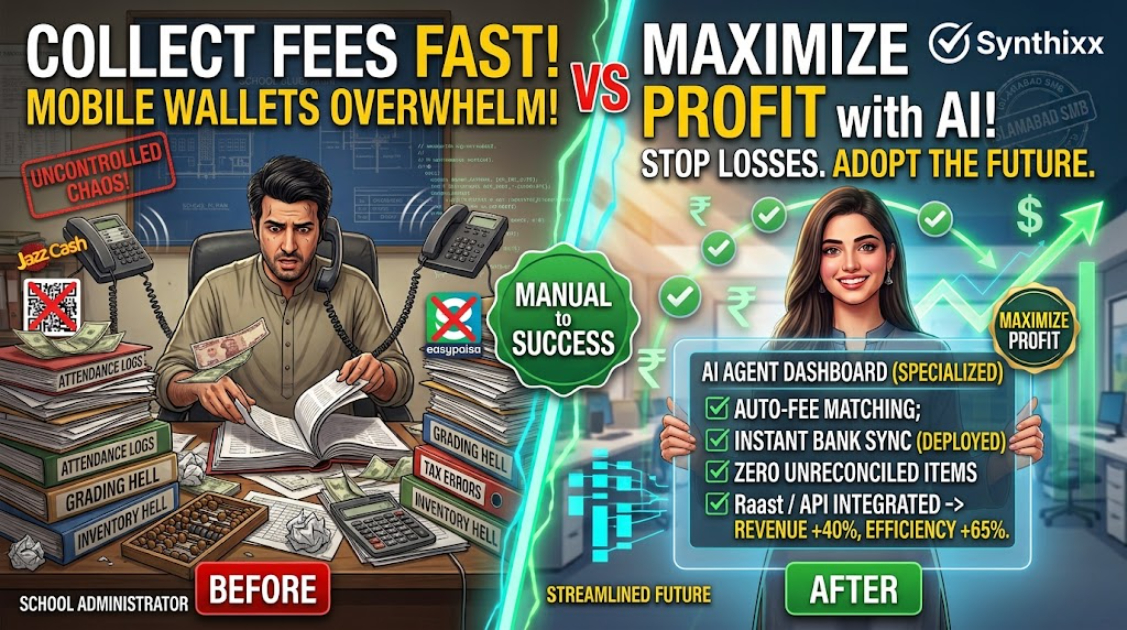
When I talk to school owners about collecting fees, the conversation always reaches the same point: "Which payment method should we actually accept?" It is a fair question, because the answer changes how quickly fees come in and how much time the office spends chasing them.
Let me compare the realistic options for a school, using mobile wallets and bank transfers as they work in South Asia ΓÇö where most parents pay through mobile wallets like JazzCash and EasyPaisa. In your country the wallet names differ, but the trade-offs are the same.
The parent's reality first
Before comparing tools, understand who is paying. In many parts of the world, especially outside big cities, many parents do not have a bank account ΓÇö but a large share of them have a mobile wallet on their phone, which they already use to pay utility bills, mobile top-ups, and online shopping.
That single fact drives everything: the easier you make it to pay, the more fees arrive on time. A payment method that requires a parent to visit a bank is a payment that arrives late. In countries where bank accounts are near-universal, the equivalent question is simply which payment rails your parents already sit on.
Treat "which methods do our parents actually have?" as a question you answer with data, not guesses. A short line on the admission form ΓÇö "how will you pay fees?" ΓÇö saves you a month of office time every year. The answer will surprise you, and it is the only honest basis for the decision below.
The mobile wallet option
- ΓÇóReach: In South Asia, networks like JazzCash and EasyPaisa are among the largest in the country, and the pattern repeats across emerging markets ΓÇö M-Pesa in East Africa, Paytm and UPI in India, GCash in the Philippines, PIX in Brazil.
- ΓÇóWhat schools use: Wallet merchant accounts let you receive payments to a business number and reconcile them against a reference (like a student ID or invoice number).
- ΓÇóStrengths: Massive user base, parents already have the app, low friction for the payer.
- ΓÇóWeaknesses: Transaction limits on personal accounts; merchant accounts need proper KYC and paperwork. Customer support response times vary.
- ΓÇóBest for: Most private schools and tuition centres that want parents to pay from their phones.
Bank transfer (online banking / instant transfer)
- ΓÇóWhat it is: Parents transfer fees from their bank account to the school's account using online banking or an instant transfer rail.
- ΓÇóStrengths: Instant, verifiable, no wallet limits for larger amounts; good for annual fees and big instalments.
- ΓÇóWeaknesses: Requires the parent to have a bank account and app. Many parents do not. Reconciliation can be slow if parents do not write the correct reference.
- ΓÇóBest for: Larger schools, branches, and colleges where parents are more likely to be banked, and for big-ticket payments.
Cash ΓÇö still part of the picture
Whatever you digitize, cash remains reality for many families, and it should stay on your books. The goal is not to abolish cash; it is to remove the friction that makes people pay late. Record cash on the same ledger as everything else, with a receipt, and it stops being a reconciliation problem.
A practical comparison table
This table condenses the three options. The column that matters most is the first one, because it answers the question that determines everything else: does the method require a bank account or not?
| Factor | Mobile wallet | Bank transfer | Cash | | --- | --- | --- | --- | | Parent needs a bank account? | No | Yes | No | | Paying takes | Seconds | A few minutes | A visit to the office | | Works on cheap phones | Yes | Needs the bank app | Yes | | Transaction limits | Medium | High | High | | Reconciliation | By reference number | Best with clear reference | Manual receipt | | Best for | Most schools | Colleges, large fees | Some families, always |
How to choose for your school
Under 200 students, mostly local families: Accept whatever wallet your parents already use plus cash at the office. Keep the register simple. The goal is to remove the "I could not find the bank" excuse.
200 to 800 students: Add a payment reference system ΓÇö an invoice number or student ID that parents must write in the comment field. This is what makes reconciliation possible without a full-time accountant.
Multiple branches or college level: Add bank transfer as an option for large payments, and consider a proper school management system with a payment gateway if your volumes justify it.
The pattern behind these tiers is worth naming: start with whatever your parents already use, add structure only when volume demands it, and let a proper system take over when the office starts drowning in reports. Every school I have seen that skipped a tier paid for it in reconciliation hours.
Reconciliation: the part everyone forgets
The method matters less than the discipline of matching payments to students. Here is a simple system:
1. Every payment must carry a reference ΓÇö invoice number or student ID. 2. At the end of each day, match that day's wallet and bank reports against the ledger. 3. Flag any payment with no reference and resolve it the same week, not the same quarter.
The three-step list looks boring, and that is the point. Schools fail at reconciliation not because the method is hard but because they skip the daily step. Ten minutes every evening beats a weekend every month.
If your payment volume is high, do this matching in software that already knows each student's balance. That is where a school management system pays for itself ΓÇö the reminder and the payment live in the same place.
A note on fraud and safety
- ΓÇóNever share the office number's OTP with anyone claiming to be from the wallet company. Support never asks for it.
- ΓÇóVerify merchants. Open the business account only through official channels, not a middleman on a social network.
- ΓÇóKeep records. Save wallet payment screenshots and bank statements. They are your evidence if a parent disputes a payment.
Frequently asked questions
Can we accept cash alongside wallets? Yes, and you should. Wallets remove friction; cash remains reality for many families. Just record cash on the same ledger as everything else.
What about payment through the school's own app or website? A school management system with a payment gateway is a later step, usually worth it at larger volumes or for annual fee collection. Start with the payment rails your parents already use.
Are there charges for receiving payments? Wallet merchants and banks take a small fee per transaction, and there may be monthly charges for business accounts. Compare a few offers before signing, and factor the fee into how you handle late payments.
Do parents need to understand wallets to pay? No ΓÇö that is the point. Your job is to make paying as easy as topping up a phone. If a parent can buy mobile credit, they can pay a fee.
The best payment method is the one your parents will actually use. For most schools, that is a mobile wallet ΓÇö and the school that accepts it, and records it cleanly, collects more of what it is owed with less office drama.
Jawad Zaheer Kyani
Founder & Software Engineer at Synthixx
Jawad Zaheer Kyani is the founder of Synthixx Technologies. He is a software builder from Muzaffarabad, in the beautiful valleys of Azad Jammu & Kashmir, and he founded the company on a simple belief: practical software should work for people everywhere, not just in Silicon Valley. He runs Synthixx with one rule — ship tools that still hold up on a busy Tuesday, not slides that only look good in a meeting.He founded Synthixx in the valleys of Azad Jammu & Kashmir with a simple ambition: to prove that world-class, practical software can come from anywhere — and to put his region on the global map. Every article on this blog is written or reviewed by him, grounded in the day-to-day work of actually building the products.Before starting Synthixx, he spent years building software for schools, startups, and businesses across Pakistan and internationally. He writes about AI, school management, free tools, and the real challenges of building technology outside of major tech hubs.
View full profile →